Ene 14 2010
2. Spatial aspects about the web hyperfiction «Lasting Image»
In this page, we will comment the important space that appear in the hypertext. The images of the texts in the hypertext sometimes are what the texts describe.
We know that the main country is Japan because the name of the places that appear came from this country.
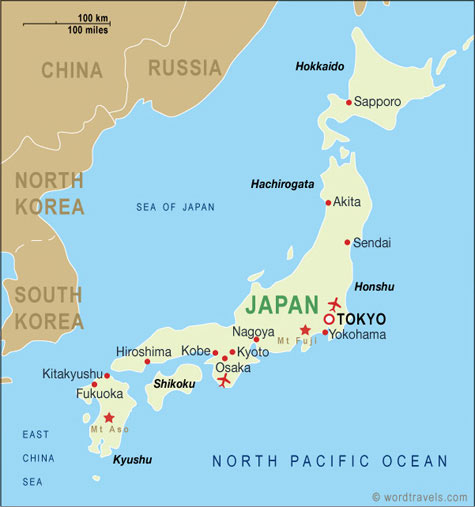
Map of Japan
- In the page 1 : Lasting Image.
In the text, it mentions about the small fishing village below Yokohama, before that the port was created in 1859.
Yokohama is the capital city of Kanagawa Prefecture. It lies on Tokyo Bay, south of Tokyo, in the Kanto region of the main island of Honshu.
Its location we can observe in the map of Japan.

The fishing port
- In the page 2: Blind Man
Only, the village is appear.
During the hypertext, the name of village and the name of the narrators are not discovered for the reader. In this way, the history come back more interesting for the readers.

Village
- In the page 3: Red Pagoda
In this part of the hypertext, the narrators tell us an important element in the history. Meisetsu is blind because of the light at Nagasaki.

Nagasaki and Hiroshima: the two atomic bombs against Japan
Nagasaki was, where on august 1, 1945 (II World War), a number of conventional high-explosive bombs were dropped on the city.
For this reason, Meisetsu is blind.
- In the page 4: Bay Hills
The town, the wood and the mountains are mentioned, but in any moment the places are specificed.
The image of the page and the title are similars. It is the hills of the bay where the sampans and canyon sail.

The hills and the bay of the text
- In the page 5: Red Bridge
Fujiyama is mentiones because the history tells us that Meisetsu has taken it a photograph with his special camera.

Fujiyama: the highest mountain of Japan
Fujiyama is the highest mountain in Japan at 3,776 m . Along with Mount Tate and Mount Haku, it is one of Japan’s «Three Holy Mountains» . An active volcano that last erupted in 1707–08, Mount Fuji is just west of Tokyo, and can be seen on a clear day. Mount Fuji’s exceptionally symmetrical cone is a well-known symbol of Japan and it is frequently depicted in art and photographs, as well as visited by sightseers and climbers.
Extracted to: http://en.wikipedia.org/wiki/Mount_Fuji
In this case, the narrators tells us that Fujiyama is perfect in its symmetry (curve of a sampan and a skirt).
- In the page 6 : Fuji
In this page, there is a description of a space outside the village. The place situated near to the Buddhist Temple (where Meisetsu lives in).
The place is near the river; there are flowers like orchid and poppies…

Oldest Buddisht Temple
We find an interesting page about the Buddhist Temple :
| Doctrines | Buddhist temples, though frequently built on the site of existing shrines in Japan, have a different ostensible purpose from a Shinto shrine. Temples are generally dedicated to transcendent and universal named Buddhas or bodhisattvas who are not restricted to the area of the temple itself. Buddhist divine beings are represented iconically and worship is conducted according to the rites of a particular denomination or sect of Buddhism, whose teachings are preserved in extensive scriptures. The purpose of Buddhist ritual, meditation etc. is to produce merit, to purify the senses and to advance oneself or another (e.g. an ancestor or spirit) on the path towards liberation or enlightenment. Doctrines associated with a particular Buddhist temple in Japan usually derive from Buddhist teachings from India or China, as well as having features peculiar to the local situation. In practice however, a Buddhist temple may be regarded by devotees very much in the same ay as a Shinto shrine, as a seat of sacred power or energy whose resident deity is able to bestow benefits on the supplicant or worshipper who visits the temple. The main function of a Buddhist temple in Japan is to conduct memorial rites for the dead. Such rites are performed over a period of many years in order to secure the passing of the ancestral spirit from this world to the realm of Buddha. | |
| History | The syncretic approach of the Japanese to Buddhist and Shinto divinities was reflected throughout Japanese history in a close institutional association, to the point of merger, of Buddhist temples and Shinto shrines. They hosted common festivals and rituals, displayed common iconography and were often administered by Buddhist monks who served also as Shinto priests until the ‘separation’ of Buddhas and kami (shinbutsu bunri) in 1868. Since then people have continued to visit both shrines and temples but on separate occasions; Buddhist temples typically to carry out funeral and memorial rites, and Shinto shrines rituals of purification and renewal. | |
| Symbols | Depending on its size and function, a Buddhist temple may contain a worship hall with altar and statue of the Buddha/bodhisattva, a meditation hall, a pagoda, and various other smaller shrines and buildings including shrines to ‘Shinto’ kami. The Buddhist tradition, particularly in its esoteric forms (Tendai and Shingon in Japan) is rich in representational and symbolic art and sculpture. The symbol used on maps for a Buddhist temple is the swastika. | |
| Adherents | About 80% of Japanese identify themselves as Buddhist (as well as following Shinto customs). | |
| Headquarters/ Main Centre |
Buddhism is divided among several major and numerous minor denominations in Japan, each with its head temple. Significant headquarters temples include the Shingon headquarters on Mt Koya, the Jodo Shinshu head temples in the centre of Kyoto and Enryakuji, the headquarters of the Tendai sect situated on Mt. Hiei, outside Kyoto. |
Extracted to : http://philtar.ucsm.ac.uk/encyclopedia/shinto/budtemp.html
- In the page 7: Fisher Huts
The narrators talk about the fisheman´s hunts where they drank saki.
In the images of the » Lasting Image», we can observed the hunts.

Fisher huts
- In the page 8: Country Inn
We can read about the narrators that they talk about the inn where they sleep. The description of the inn is » … iluminated with a powder of dried phosphorescent seaweed, the inn´s broad roff sheltering wide porches dotted with moths that gathered moonlight.»
Extracted to: http://www.eastgate.com/LastingImage/countryinn2.html

Country inn
- In the page 9: Sampans
«The sampans are a relatively flat bottomed Chinese wooden boat from 3.5 to 4.5 m long. Some sampans include a small shelter on board, and may be used as a permanent habitation on inland waters. Sampans are generally used for fishing or transportation, in coastal areas or rivers. It is unusual for a sampan to sail far from land as they do not have the means to survive rough weather.»
Extracted to: http://en.wikipedia.org/wiki/Sampan

Sampans
- In the page 10: Distant Abode
In the last page, the narrators tells us that they stake to know who sleep with the Geisha or not. But there is not any specific place.
All of those pages form the lineal reading of this hypertext.
We should remember that the images of the pages and the title is very similar, but with the text do not sometimes fit in.